on Monday, 18 November 2013

SO REALLY.. HOW OFTEN DO THEY SPEND THEIR TIME WATCHING TELEVISION?


This is the latest statistic, updated 9.7.2013, by BLS American Time Use Survey, A.C. Nielsen Co., shows that an average American spends 9 years of their standard lifespan watching television. Commercials and advertisements are slipped in between each television program, so unmistakeably that is also the rough amount of time they spend watching advertisements after advertisement during commercial breaks.

But after spending 952 days actually observing media consumers, the study found that while watching 8½ hours of video content per day, viewers are exposed to 61 minutes worth of commercials.

But, nowadays the number of people watching televisions are slowly decreasing, due to the new technologies such as iPad, Galaxy Tab and etcetera that enables consumers to simply download ad-free videos and movies. Unlike Youtube, which has the commercial before you can 'skip' after the 5 second-rule, videos through torrents and online streaming lack commercials nowadays.

What Types of Commercials Attract More Attention?

You don't require a TV to see a commercial these days. Thanks to the Internet, commercials can now be e-mailed, shared on Facebook, blogged about and tweeted about - all potentially resulting in millions of additional views.

To receive more views and lasting impressions, companies are competing in this advertising arms race using two primary tactics: Comedic Commercials and Bashing the Competition Commercials.

In their constant quest to attract consumers and associate products with “cool” or luxurious and 
hedonistic lifestyles, some advertisers have consistently pushed the boundaries of what is ethically and socially acceptable. American advertising has always embraced erotic suggestiveness while usually staying clear of full nudity and explicit sexuality. Campaigns that blur that distinction often arouse controversy and even protest. 

By Erica C.

*This post is strictly unofficial. For educational purposes only and is based on student opinion and research. Not for any other uses.

References

“Television Watching Statistics – Statistic Brain.”
2012 Statistic Brain Research Institute, publishing as Statistic Brain.
17 November*
http://www.statisticbrain.com/television-watching-statistics/.

anon. 2006. The Economic, Social, and Regulatory Aspects of Advertising. [ONLINE] Available at:http://www.aef.com/pdf/arens_ch03.pdf. [Accessed 17 November 13].

on Sunday, 17 November 2013
http://thumbs.dreamstime.com/x/family-having-breakfast-18543425.jpg
Family Having Breakfast

Our group would like to re-create this advertisement due to its unintended insensitivity to the victims of eating disorder in American society. In America, approximately 8 million Americans suffer from eating disorders and it is increasing daily with the publicity on television & fashion models on 'HOW WOMEN OR MEN SHOULD LOOK LIKE - PERFECT'.

Here are the information considered to recreate the ad:

Target Audience:
American Society. Core buyers of Yoplait are women (aged 18-49).

Message:
Eating Yoplait Lite is healthier. "Never again will taste buds be put on a diet! With such a wide variety of flavors, Yoplait® Light has made managing your weight absolutely delicious. With 20 flavors at 90 calories, Yoplait Light makes healthier eating SO good!"

While the message to be conveyed to the consumers is that eating Yoplait Lite is a healthy choice, this Yoplait ad need not restrict its ad to the scenario where a woman has to choose between a slice of cheesecake or a Yoplait Lite. It can be considered cliche for a yoghurt advertisement to depict such a scene. In fact, our group would like to expand the the target audience of this Yoplait Lite advertisement. Since it is a health based Yoghurt, there are many Americans out there who are conscious about their own health and the population of them are not only women but men too. Also, the target audiences of women need not be staple only to working women, but also young teenagers for health reasons and even healthy families having breakfast! As a matter of fact, there are many ways to portray the goodness of Yoplait Lite that need not touch on the sensitivity of eating disorders according to our following research on 'American Health & Culture Lifestyle'. Most likely, if this Yoplait Lite ad had not been pulled down, it would have resulted in an opposite effect intended by the advertiser & company (refer to Consumer Reception Towards Bad Ads Over Long Run post).

References:

- Yoplait, 2013. Yoplait light yoghurt. [online] Available at: <http://www.yoplait.com/products/yoplait-light> [Accessed 16 November 2013].

- Dreamstime, 2009.  Family Breakfast. [electronic print] Available at: <http://www.dreamstime.com/royalty-free-stock-photos-family-breakfast-image11016838> [Accessed 16 November 2013]. 

BY VANESSA VERA.
*This post is strictly unofficial. For educational purposes only and is based on student opinion and research. Not for any other uses.


TELEVISION, COMMERCIALS AND AMERICAN


Television is one of the major mass media in USA. At least 96.7% households in USA have 1 TV. America has the largest television network in the world. As of August 2013, there are approximately 114,200,000 American households with television.

A survey that was taken on first quarter of 2012 showed that people (American in this case) watch more television as they grow older. The survey showed that children aged 2-11 spent an average of 24 hours of TV per week. That number decreased to 22 hours for teens aged 12-17, but it goes back up to 25 hours for adult teens aged 18-24. After that, the number increases steadily until people over 65 with average 48 hours a week. Men spent more time in these activities than women did.

Watching TV was the leisure activity that occupied the most time (2.8 hours per day), covering for about half of leisure time (such as socializing, browsing internet, etc.).

Looking at those statistics, you could say that American spent almost all their times a day watching television. That way, people can not avoid watching commercials. In fact, some of them like to watch for commercials, to check on what's new today. Some research showed that number of TV commercials seen by the average person by age 65 is 2 million. Therefore, I can conclude that TV takes a big part of American culture.

Now, I'm gonna talk about how TV ads affect culture. Actually, instead of saying it affects culture, it more to how TV ads reflect culture. From time to time, TV ads always targeting on what the customers wants, what they dreamed of. For instance, some ads, lets say Victoria Secret's ads, they show how the look of Miranda Kerr, Rosie Hunthington, how sexy, pretty, and perfect they are after they used the product. That's what everyone dreamed of. Even though sometimes the product won't give you the result that you expected. How does it reflect to culture? Back to what we've said before, society pictured "beauty" as skinny. Well, in fact, almost all ads that average people watch everyday have one thing in common, they are idealized. Idealization here means that whatever's happening in the ads nowadays always follows where the culture is going right now.

In conclusion, TV is a mass media that we can't avoid in everyday life. People unconsciously spent a lot of time on it. They will also remember all the ads they have seen, because they will see it not only once, but over and over again. People usually buy stuff they saw on ads by expecting what they saw to happen. But, even though they don't get what they expect. They won't think too much of it. They will just stop buy those products.


By: C. Tanata

*This post is strictly unofficial. For educational purposes only and is based on student opinion and research. Not for any other uses.

References :

Bureau of Labor Statistics. 2013. American Time Use Survey Summary. [online] Available at: http://www.bls.gov/news.release/atus.nr0.htm [Accessed: 17 Nov 2013].
Herr, N. 2013. Television and Health. [online] Available at: http://www.csun.edu/science/health/docs/tv&health.html [Accessed: 17 Nov 2013].
Hinckley, D. 2013. Americans spend 34 hours a week watching TV, according to Nielsen numbers Read more: http://www.nydailynews.com/entertainment/tv-movies/americans-spend-34-hours-week-watching-tv-nielsen-numbers-article-1.1162285#ixzz2kvXML9g5. [online] Available at: http://www.nydailynews.com/entertainment/tv-movies/americans-spend-34-hours-week-watching-tv-nielsen-numbers-article-1.1162285 [Accessed: 17 Nov 2013].
Sundem, G. 2013. How do TV commercials influence American culture?. [online] Available at: http://people.howstuffworks.com/culture-traditions/tv-and-culture/commercials-influence-american-culture.htm [Accessed: 17 Nov 2013].
on Saturday, 16 November 2013
Skipping breakfast is commonly thought of as a weight loss method. However, breakfast is crucial to maintain a healthy digestive system, which directly relates how our body processes what we eat and drink, to our weight. In America, it is common for people to skip breakfast with the excuse that they have no time for it, or they do not feel the need. Another equally unhealthy breakfast culture is eating junk food for breakfast. Grabbing a Happy Meal, or a Big Mac with fries with a Coke on the side is a definite no. Unfortunately, the breakfast culture is to go for something fast and cheap, or nothing at all.


The "American Breakfast"

As stated above, this is an image of a typical American breakfast. However, fast food chains caught onto this and started making their own breakfast sets. For instance, McDonald's created the Sausage McMuffin with scrambled eggs and hash browns. Common members of the breakfast family, yet chemically modified, with high levels of salt, preservatives and other unfriendly additives. High fat, high sugar instant meals are easily obtained and cheaper than healthy foods. The fast lane life that is the American way of life naturally accepted this with ease as the food is sold at a low price, can be eaten on the go, and generally tastes okay. Over time, the originally healthy American breakfast culture of home made pancakes topped with blueberries and a side of hash browns started to fade and the fast food industry started to take over. Hence, the American breakfast culture started to deteriorate without the Americans themselves realising.

*This post is strictly unofficial. For educational purposes only and is based on student opinion and research. Not for any other uses.

References:

Fast-food culture serves up super-size Americans . 2013. Fast-food culture serves up super-size Americans . [ONLINE] Available at: http://www.apa.org/monitor/dec01/fastfood.aspx. [Accessed 16 November 2013].

Diet Diary: Fast Food Breakfast's Best and Worst Choices! Morning Nutrition on the Go! | UrbLife.com - The Voice of Gen-X Lifestyle. 2013. Diet Diary: Fast Food Breakfast's Best and Worst Choices! Morning Nutrition on the Go! | UrbLife.com - The Voice of Gen-X Lifestyle. [ONLINE] Available at: http://www.urblife.com/the-life/fast-food-breakfast/. [Accessed 16 November 2013].

by: syafiq.R
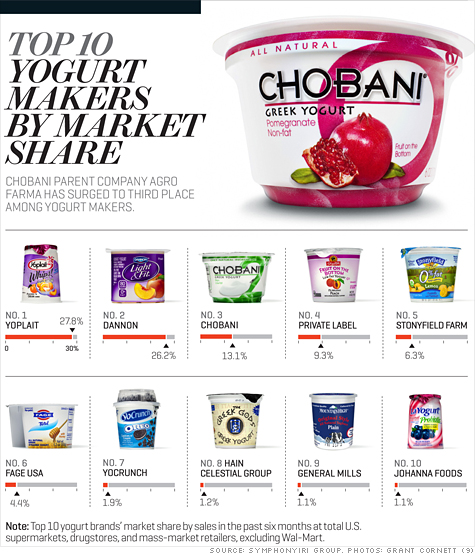
The picture above show the top 10 yogurt brands separated by it's market share in the year of 2011. In the chart shows that Yoplait have been in the number one position in term of the market share of it's company. Despite the competition of the company market share, in this research shown that Yoplait is also a number one choice for the American's society.


In this year research of the popularity of the yogurt brands in the American's society. The result for the top five are Yoplait, Chobani, Stonyfeild Farm Oikos Greek, Dannon, Stonyfield Farm.

Yoplait's yogurt range include original, light, thick, creamy, lactose-free varieties, in this year Yoplait launch their very own Greek range yogurt. However the new launch doesn't really get the expected result. According to Yoplait learning from the result,  "many consumers were not fully statisfied with the fruit on the bottom and aftertaste of its current Greek offering."


References
- Astley, 2013. Top 5 US Yogurt Brands - Yoplait top, Chobani Toppled, Dannon trails... .[online] Available at: <http://www.dairyreporter.com/Manufacturers/Top-5-US-Yogurt-Brands-Yoplait-top-Chobani-toppled-Dannon-trails> [Accessed on 14 November 2013]

-    Prasso, 2011. Chobani: The unlikely King of yogurt. [online] Available at: http://money.cnn.com/2011/11/29/smallbusiness/chobani_yogurt_hamdi_ulukaya.fortune/  [Accessed on 16 November 2013]


By
Li En
*This post is strictly unofficial. For educational purposes only and is based on student opinion and research. Not for any other uses.
http://gb.fotolibra.com/images/previews/35002-boy-drinking-sour-milk-illustration.jpeg
Reaction to Sour Milk.


Bad Advertising are synonym to fresh milk turning sour overnight. Some bad ads have been pulled down immediately after critical reception from society but that's because the ineffectiveness of it was distinct. However, if you think your ad is good or acceptable just because it has not been pulled down does not mean that it is EFFECTIVE. Indirect bad advertisement that runs over a long period of time may cause an opposite reaction or effect than the intended response the advertisers need. So, perhaps in light of the insensitivity towards victims of eating disorders in America, it is a good deed for the Yoplait Lite advertisement to be pulled down because even though it does not affect the other half of society, Yoplait will still lose approximately an amount of their consumers if they choose to ignore the fact that they have stirred discomfort within said victims who viewed their advertisement.

Advertisements over a long-run can create either positive or negative results. For bad advertisements of course, the outcome will not be favorable. How effective a commercial is will be influence by the message strategy and the execution of the message (Yeshin,T, 2006). If Yoplait Lite happened to receive negative responses from a portion of its society as researched in YOPLAIT LITE - Making light of those suffering from eating disorder? and THE VICTIMS AND THE FACTORS CAUSE OF THE PROBLEM then it only means that the ad was ineffective.

If Yoplait Lite ad had not been taking down, it would have impacted the consumers' image of the brand itself. Successful advertising is therefore which builds product or service image and company reputation, both of which are key components of perceived quality (Yeshin,T, 2006).

In Tellis's (2003) research, he discovered that when advertising efforts are maintained over a period of years, its effects can stretch over a length of two or more years. We assume that this implies for both positive and negative receptions.

Emotional tendencies also influences the aspects of long term advertising effects (Hansen,F & Christensen, S.R, 2007).

Basically,long-term effects come after the medium effects and in regards to this Yoplait Lite ad that our group is focusing on, the brand image of Yoplait itself might not be wholly destroyed but perhaps fractured in the mind of a portion of society who suffers from eating disorders - IF - only they had not taken down the Yoplait Lite ad initially. Consequently, this will automatically affect the sales of Yoplait itself and putting ourselves in the company's shoes, we will not want that to happen - at all. I guess we could sum up that the primary effect of Bad ads in long run will brand a bad experience in the mind of consumers and in terms of consumer psychology, it will stay in the minds of the affected victims of eating disorders - known as autobiographical advertising.

As written by Elster & Loewenstein (1992), previous experiences can play a significant role in how the consumer perceives the product. For example, as said by Jenni Schaefer, "
I was shocked by how they really nailed it on the head--that's exactly what I thought every time I opened a refrigerator door. When you live with an eating disorder, you divide all foods into "good" and "bad" categories, like the yogurt versus the cheesecake [in the commercial]". 
This quote solidifies the fact that Schaefer's unattractive past or memories with her own eating disorder has led her to feel discomfort about seeing an advertisement that reminds her of her own past. In fact, it probably opens old wounds. 

Negative memories are unfortunate to the brand if the consumer allows their bad memory to dictate whether they would use the product or not. This memory becomes an obstacle to consumer happiness and in future, they may not think much of this particular brand (Jansson-Boyd, C, 2010). Or they may not even buy the product or services in the future. 


References :

-  Jansson-Boyd, C, 2010. Consumer Psychology. Berkshire : McGraw-Hill International.
-  Yeshin,T, 2006. Advertising. London : Cengage Learning EMEA.
-   Hansen, F & Christensen, S.R., 2007. Emotions, Advertising and Consumer Choice. Copenhagen :
Copenhagen Business School Press DK. 
- Müller, J, et. al, 2011. Pervasive advertising. London : Springer.
- Kelly,M, 2005. Boy Driking Sour Milk - Illustration. [electronic print] Available at: <http://www.fotolibra.com/gallery/35002/boy-drinking-sour-milk-illustration/> [Accessed 16 November 2013]. 
 
 By VANESSA VERA.
*This post is strictly unofficial. For educational purposes only and is based on student opinion and research. Not for any other uses.  

on Wednesday, 13 November 2013
Looking at the full picture, American eating culture is considered to be the worst in the world. With the highest rate of obesity and other eating disorders, one has to wonder how this came to be.

Americans are well known for fast food. It runs in their blood. From road side stalls selling the greasiest, oiliest burgers, fancy restaurants selling pizzas, to large chains such as McDonalds and KFC. But have you noticed, most of these are not native American culture? The American eating culture has been largely influenced by the vast variety of races which construct the American society. For instance, pizzas are an Italian dish, tacos are of Latino origin, and tandoori came all the way from India.

In their original condition, these foods are healthier. But in mass production to cater for the American population, large food chains added additives to prolong the shelf life of the foods and added excessive amounts of salt and sugar to severely unhealthy measures to improve the taste of the foods.

If it tastes better, it sells better. Everyone knows fast food is unhealthy, but other than the low prices, taste and variety, there is one thing that influences the human mind towards consuming something which is slowly killing them. The media.
Doesn't that look good? Thick juicy patties and fresh lettuce, added with it being in a high end social environment, makes you want it. Now. McDonald's marketing executive insisted that the very same ingredients are used in the 'TV burgers' and the burgers we eat when the chain was challenged by a child who simply asked: why do the burgers look different? 

If they were to use the very same burgers we get at the counter in their ads, McD would probably go bankrupt. After all, who would eat such sad looking patties sandwiched between soggy lettuce, smelly cheese and two pathetic buns? This is what caught the world off guard, especially the American population. If you cannot imagine the whole scale of unhealthy eating and fast food consumption, imagine the add above and multiply it by at least 100 for the hundreds of fast food chains out there pushing millions of deadly burgers over their counters. The media's role in this process it to make something you don't need look so good, that you think you need it. By subconscious association and a bit of good lighting and camera angles, they can make anything look good. Or simply, make you want anything.

Refferences:

Food, Culture, and Diabetes in the United States . 2013. Food, Culture, and Diabetes in the United States . [ONLINE] Available at: http://clinical.diabetesjournals.org/content/22/4/190.full. [Accessed 13 November 2013].

11 Facts About American Eating Habits | Do Something. 2013. 11 Facts About American Eating Habits | Do Something. [ONLINE] Available at: http://www.dosomething.org/tipsandtools/11-facts-about-american-eating-habits. [Accessed 13 November 2013].

McDonald's - Big Mac: "The Pop Icon" (2013) - YouTube. 2013. McDonald's - Big Mac: "The Pop Icon" (2013) - YouTube. [ONLINE] Available at: http://www.youtube.com/watch?v=qNiMQcg_orE. [Accessed 13 November 2013].

By Syafiq R
*This post is strictly unofficial. For educational purposes only and is based on student opinion and research. Not for any other uses.