on Monday, 25 November 2013

Based on our research shows there is an increase of 30% over the past four years until 2012. As the 2008 survey from Yoga Journal shows that the number for yoga practitioners were 15.8 million and the lasted number is 20.4 million.
As the statistic done on 28 july 2013, and sourced from NAMASTA, YIAS, LiveStrong and Yoga Journal shows that in America there are total of 15 million of American who practice Yoga. In that 15 million there are 72.2% is female and 27.8% is male. The age range are around 18-34 with 40.6% and 41% for the age range around 35-54, the lastly will be the age around 55 and above will be 18.1%.
The statistic also shows that different locations have the different percent of Yoga practitioners. The location have the higher percentage are the Northeast and Midwest (including Ohio)  with 30% over the total of 100% of the whole America. The other will be 20%% for West Coast and the other parts in America.
The Yoga industry in the America also shows a great market for Yoga related products. As the amount of the American spent annually on yoga products are $27 Billion. The percent increase on yoga products spending over the past 5 years are as high as 87%, with the average annual increase of 20% of the number of people who practice yoga. This can prove that yoga have been accepted and also as part of the America’s culture, American can easily relate themselves with any yoga or healthy related products or services. 

In conclusion, this research about yoga is to determine the statistics of women in America who participate in this form of exercise, in order for us to recreate the ad for Yoplait Lite. Since yoga is one of the leading form of exercise within the female category in America, then the target audience of our ad will be able to relate better to why yoga is being used in our ad. Yoga equals taking care of yourself (healthy), so why not link it to lite and healthy Yoplait yoghurt to it? "A healthy meal for a healthy woman".


Reference
2012, American Yoga: How Many People Practice In The United States? [Online] Avalable at: <http://www.huffingtonpost.com/2012/12/06/american-yoga_n_2251360.html> [Accessed on 26 November 2013]

2013, Yoga Statistics. [Online] Available at: <http://www.statisticbrain.com/yoga-statistics/> [Accessed on 26 November 2013]


By
Li En
*This post is strictly unofficial. For educational purposes only and is based on student opinion and research. Not for any other uses.


*This post is strictly unofficial. For educational purposes only and is based on student opinion and research. Not for any other uses.
It has been reported that people tend to focus more to the left side 
of the screen rather than the right. Studies show that the main reasons for 
this is because our horizontal attention leans to the left, and also
most languages in the entire world are written from the left to the right side of the 
screen. Web designers have also made it a point to put navigation bars and bits of
information towards the left side of the websites they create. 

Web users spend 69% of their time viewing the left half of the page and 30% viewing the right half.
A conventional layout is thus more likely to make sites profitable.


In this chart, each bar shows the amount of time users spent on fixations within a 100-pixel-wide stripe running down the screen, starting from the very left.


People spent more than twice as much time looking at the left side of the page as they did the right:

Left half of screen: 69% of viewing time
Right half of screen: 30% of viewing time


In conclusion, this research was done to clarify which side of the screen a normal TV user would focus their attention more on - the left or the right? This will help us for the technical part of our TVC as we will be using a split-screen effect.


references:

Nngroup.com. 2013. Horizontal Attention Leans Left. [online] 
Available at: http://www.nngroup.com/articles/horizontal-attention-leans-left/ [Accessed: 25 Nov 2013].


Webdesigner Depot. 2013. Understanding Your Brain for Better Design: Left vs. Right. [online] 
Available at: http://www.webdesignerdepot.com/2009/11/understanding-your-brain-for-better-design-left-vs-right/ [Accessed: 25 Nov 2013].

by: Syafiq R.

*This post is strictly unofficial. For educational purposes only and is based on student opinion and research. Not for any other uses.

STORYBOARD 1


 STORYBOARD 2 - (Revised From Storyboard 1)


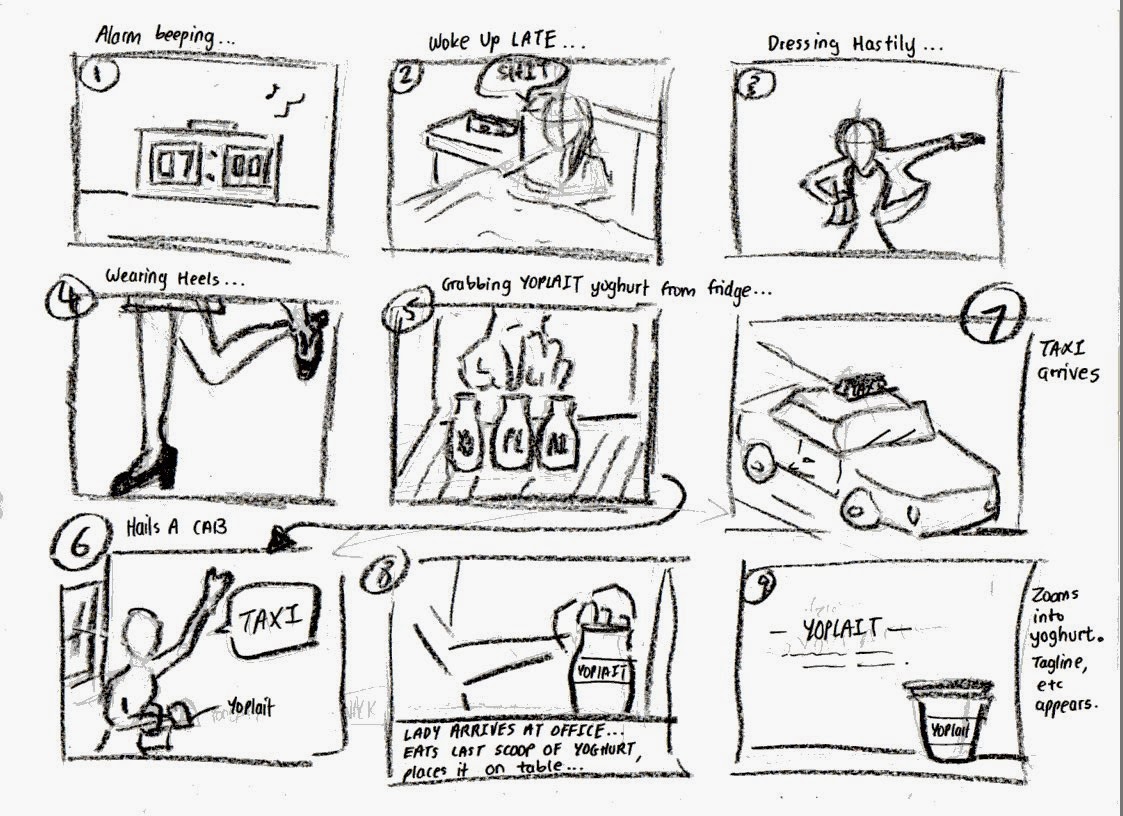
Our storyboard consists of parts extracted from our research about Yoplait Lite, American Lifestyle, American Health Culture, American Breakfast Culture etc. For this improvised TVC storyboard, it's meant to portray a healthy woman (proven by her yoga lifestyle) who wakes up in the morning to work out and get ready for work. From our research, Americans today are too busy working and they don't have the usual breakfast at the table as much as before. Of course, this TVC is targeted more towards the female audience. So, off to work our main lady goes, grabbing a Yoplait Lite with her as a substitute for breakfast. Here you can see a "grab and go" concept but at the same time, she eats yoghurt because she is health conscious person and Yoplait Lite is just the perfect healthy yoghurt for a healthy working woman.

BY VANESSA VERA.
*This post is strictly unofficial. For educational purposes only and is based on student opinion and research. Not for any other uses.


on Thursday, 21 November 2013

The Yellow Cab


After deciding to make an advertisement that involves Taxi, we decided to do a little bit research about Taxi in America, who usually use it, how often they use it, why do they use it, etc. Well, people usually call it Taxi,  but in America the word "Cab" is more popular, or alternatively "Taxi Cab".

First of all, I'm gonna tell you a little history about American Cab or Yellow Cab. In 1915, Chicago entrepreneur John Hertz launched the first Yellow Cab Company in his city. He paid a local science university to study on which color would stand out strongest from far away. And yellow is the answer. Though in 1907, a businessman Harry N. Allen opened the New York Taxicab Company, first ever gasoline-powered cabs, equipped "with taximeters", and drove by driver dressed like West Point cadets was originally painted red and green.

From what I've found, Taxi cabs is one of the most used public transport. There are at least 27,000 taxi trips per year in Las Vegas alone, that makes 70 trips per day. New York is the city with the most taxicabs, there are more than 13,000 licensed taxicabs there. Moreover, here in New York, the average number of taxi passengers is 241 million per year, which mean there are around 20 million people using Taxi in New York alone each month.

Overall, I can conclude that Taxicab is already a main transport option in America, even though of course there are plenty of tourist use this service as well. But that didn't change the fact that taxicab is American's priority in public transport, where they don't have to wait for an hour or so for other transport.

By: C. Tanata

*This post is strictly unofficial. For educational purposes only and is based on student opinion and research. Not for any other uses.


References:

Russel Gao Hodges, G. 2013. Hailing the History of New York's Yellow Cabs. [e-book] New York: Johns Hopkins University Press. p. 1. Available through: Google http://www.npr.org/templates/story/story.php?storyId=11804573 [Accessed: 21 Nov 2013].
Statisticbrain.com. 2013. Taxi Cab Statistics | Statistic Brain. [online] Available at: http://www.statisticbrain.com/taxi-cab-statistics/ [Accessed: 21 Nov 2013].
Stewart, J. 2013. Why Are There So Many Yellow Taxis in the World?. [online] Available at: http://www.slate.com/blogs/the_eye/2013/10/25/taxis_who_decided_they_should_be_yellow.html [Accessed: 21 Nov 2013].
on Wednesday, 20 November 2013
HOW CONSUMERS REACT TO A PRODUCT.
EMOTIONAL OR RATIONAL?

In the market, there are two types of consumers:

(A) Rational Consumer - the potential consumer who carefully paid attention to promotional messages before making product choices. Classic economic theory rates this particular consumer a self-interested and naturally desiring person to maximize profits while valuing time (Haugtvedt,C.P, et.al, 2012).

(B) Emotional Consumer - the potential consumer who is stimulated by advertising will encourage them to try particular products and brands. If the feel-good factor is reinforced, repeated purchases will likely occur (Wright, R, 2006).

stevensonfinancialmarketing, 2012
Here, for our re-created ad, we would like contemplate to reach out either to the target audience's rational or emotional side. There has always been a debate as to whether women or men are more susceptible to advertisements and the truth is, according to our research, women are more susceptible to emotional appeal than men, advertising could persuade women by first addressing their sentiments to attract their interest (McGovern, C, 2009).

References:

-Haugtvedt, C.P, et.al, 2012. Handbook of Consumer Psychology. New York:Psychology Press.

- McGovern, C, 2009. Sold American: Consumption and Citizenship, 1890-1945. Chapel Hill:University of North Carolina Press

- Wright, R, 2006. Consumer Behaviour. [online] Available at: <http://books.google.com.my/books?id=R329I_4nQOgC&printsec=frontcover#v=onepage&q&f=false> [Last Accessed 21 November 2013].

By VANESSA VERA.
*This post is strictly unofficial. For educational purposes only and is based on student opinion and research. Not for any other uses.


on Tuesday, 19 November 2013
According to our research shows that when Americans purchasing food and beverages, they are aware of the basic nutritional facts of the products and how does it affect their weight. Other than that they are also very concern if the products are locally sourced produced when they are doing the purchase. However they still have their own purchasing preferences and habits, when it comes to healthier choices.


  *Important point when purchasing food and beverages, is all based on adults, was done between 7-14 March, 2011*


 *Important point when managing their weight or diet, is all based on adults, was done between 7-14 March, 2011*


Based on the chart above shows that even the Americans are very health conscious, but when it comes to their own preferences with healthier choices, is still a question if they will aware of its and transform into behavior.


Reference:
2011, Most Americans Are Health- Conscious, But Behavior Varies By Age,[Online] Available at: <http://www.harrisinteractive.com/NewsRoom/HarrisPolls/tabid/447/ctl/ReadCustom%20Default/mid/1508/ArticleId/762/Default.aspx> [Accessed on 19 November 2013]   


By,
Li En

*This post is strictly unofficial. For educational purposes only and is based on student opinion and research. Not for any other uses.